
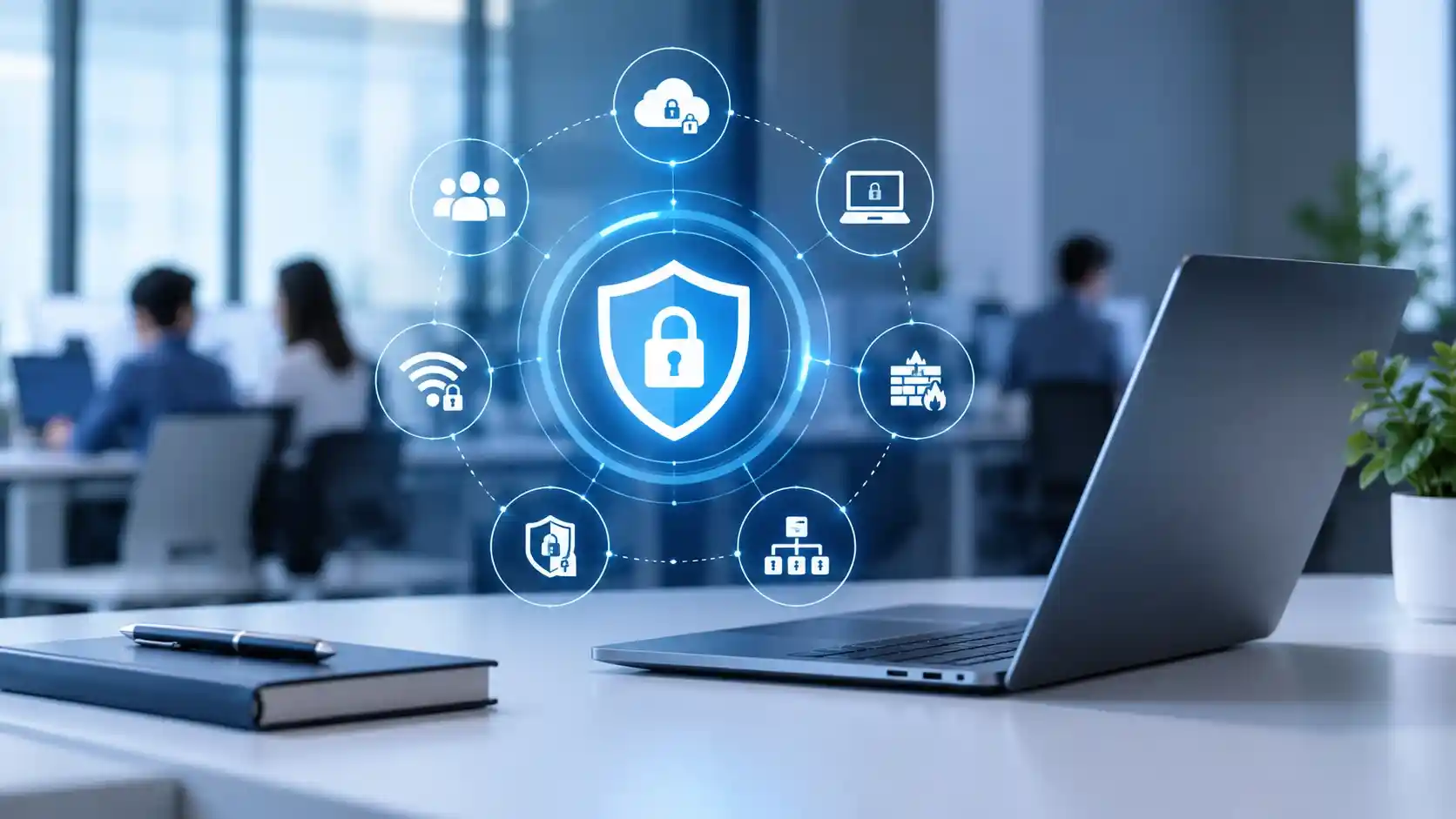
A 20–100 employee business should build layered security by protecting seven areas: user identities, email and cloud accounts, employee devices, networks and firewalls, business data, backups, and continuous monitoring. The objective is to ensure that if one security control fails, another layer can still detect, block, contain, or help the business recover from the attack.
This approach is often called a layered cybersecurity strategy or defense in depth.
For growing businesses, the biggest mistake is relying on one product—such as antivirus or a firewall—and assuming the entire IT environment is protected. Companies that lack sufficient internal cybersecurity resources can use IT AMC services in Dubai to manage security alongside networks, endpoints, cloud systems, users, and wider IT operations.
What Are the Main Layers of Business Cybersecurity?
A practical layered security model for a 20–100 employee company can include:
| Security Layer | Main Purpose |
|---|---|
| Identity | Stop unauthorized account access |
| Email & Cloud | Reduce phishing and cloud-account risks |
| Endpoint | Protect laptops and desktops |
| Network & Firewall | Control and inspect network traffic |
| Data | Restrict and protect sensitive information |
| Backup & Recovery | Recover when prevention fails |
| Monitoring & Response | Detect and respond to suspicious activity |
These layers should work together rather than operate as disconnected security products.
Layer 1: Protect User Identities
Passwords are often the first security boundary between attackers and business systems.
Your first layer should therefore focus on identity.
Businesses should consider:
- Multi-factor authentication
- Strong password policies
- Role-based access
- Administrator-account restrictions
- Prompt user offboarding
- Regular permission reviews
- Monitoring suspicious sign-ins
Employees should have only the level of access required for their jobs.
For organizations using Microsoft’s cloud environment, Microsoft 365 services and security management can support areas such as secure access, MFA, account administration, and data protection.
Identity security becomes increasingly important as businesses add remote employees, contractors, cloud applications, and additional offices.
Layer 2: Secure Email and Cloud Applications
Email is closely connected to identity security because it is frequently used to access other business platforms, reset passwords, exchange documents, and communicate with customers.
Your layered cybersecurity strategy should therefore consider protection against:
- Phishing
- Malicious attachments
- Suspicious links
- Account takeover
- Unauthorized mailbox access
- Unsafe file sharing
- Misconfigured cloud permissions
Employee awareness remains important, but businesses should not rely entirely on employees recognizing every sophisticated phishing attempt.
Technical security controls should provide additional layers around users.
If a malicious message gets through one control, identity protection and endpoint security should still reduce the potential impact.
Layer 3: Secure Every Endpoint
Every employee laptop or desktop is another potential entry point into your business environment.
Endpoint security should include more than installing antivirus once and forgetting about it.
Businesses should maintain visibility into:
- Operating-system updates
- Security patches
- Endpoint protection
- Device encryption
- Approved applications
- Local administrator access
- Device health
- Unsupported hardware or software
For example, CubeZix’s article on workstation security for business computers provides a useful checklist for reducing risks at individual workstations.
Companies using ongoing IT AMC services in Dubai can also incorporate endpoint maintenance, patching, infrastructure support, and regular technical reviews into their wider IT-management process.
Layer 4: Protect the Network With Firewalls and Segmentation
Endpoint protection should not be the only thing standing between an attacker and the rest of your environment.
Your network forms another important security layer.
A properly designed network should help control how devices communicate internally and externally.
Important measures can include:
Business-grade firewall protection
Secure Wi-Fi configuration
VPN or secure remote access
Network segmentation
Traffic monitoring
Regular firmware updates
CubeZix’s firewall installation and configuration services can support businesses that need stronger perimeter protection, remote-access security, traffic control, and firewall management.
Businesses should also consider ongoing network support and monitoring because cybersecurity is not simply about installing a firewall. Network configurations, devices, firmware, user demand, and threats change over time.
Layer 5: Protect the Data Itself
A strong layered cybersecurity strategy assumes something could eventually get through.
That means the data itself should also have protection.
Important business information may include:
- Customer records
- Financial documents
- Employee information
- Contracts
- Intellectual property
- Internal communications
- Credentials
- Business databases
Businesses should determine who actually requires access to each type of information.
Encryption can add another important defense. Even if unauthorized individuals obtain certain information, appropriately implemented encryption can make that data significantly harder to use.
CubeZix’s guide explaining why businesses need data encryption provides additional guidance on protecting sensitive information across devices and communications.
Layer 6: Treat Backup as a Cybersecurity Layer
Backups are sometimes treated purely as an IT maintenance task.
They are also an important security layer.
Imagine that malware bypasses email filtering.
An employee opens it.
Endpoint security fails to stop it.
The attack reaches important business data.
At that point, your ability to recover may depend on the backup and disaster-recovery layer.
Businesses should consider:
- Automated backups
- Offsite or cloud copies
- Protection of backup credentials
- Recovery testing
- Defined recovery priorities
- Backup monitoring
CubeZix’s data backup and disaster recovery services can support organizations that need structured backup and recovery planning.
The important principle is:
A backup is useful only if the business can successfully recover from it when required.
Layer 7: Add Continuous Monitoring and Response
The final layer connects the others.
A company can deploy strong security technologies and still remain vulnerable if nobody notices when those systems generate warnings.
Monitoring may include:
- Failed login attempts
- Unusual sign-in locations
- Endpoint alerts
- Firewall events
- Backup failures
- Network anomalies
- Missing patches
- Devices going offline
- Suspicious administrator activity
The security process should therefore be:
Detect → investigate → contain → fix → document → improve
CubeZix discusses why unmanaged systems create opportunities for attackers in its article on how hackers exploit poorly managed business IT environments.
Monitoring turns security from a collection of products into an ongoing operational process.
Why 20–100 Employee Businesses Need Layered Security
Security complexity rises quickly as a company grows.
A 20-person business may have dozens of laptops and cloud accounts.
At 100 employees, the organization may also operate multiple networks, servers, Microsoft 365 accounts, remote users, SaaS applications, backup systems, firewalls, shared data, and privileged administrator accounts.
One IT employee may not have specialist expertise across every security layer.
This is where a structured external IT team can help. Rather than managing cybersecurity, networking, cloud administration, endpoint support, and infrastructure as separate problems, IT outsourcing services can bring these responsibilities under a coordinated operating model.
How the Security Layers Work Together
Consider a phishing attack.
Layer 1: Email security attempts to identify the malicious message.
If that fails:
Layer 2: MFA may prevent stolen credentials from immediately granting account access.
If a device is attacked:
Layer 3: Endpoint protection may detect malicious activity.
If that fails:
Layer 4: Network controls can help limit what the compromised device reaches.
If files are affected:
Layer 5: Access restrictions can reduce exposure.
If ransomware encrypts data:
Layer 6: Recoverable backups can support restoration.
Throughout the process:
Layer 7: Monitoring can alert IT that something abnormal is happening.
This is the real advantage of layered security: no single security product carries the entire responsibility for protecting the business.
Where Should a Business Start?
Do not begin by buying seven different security products.
Start with an assessment.
Identify:
- Users and administrator accounts
- Business-critical applications
- Laptops and endpoints
- Network infrastructure
- Sensitive data
- Backup systems
- Existing security monitoring
Then look for gaps between those layers.
For example, a company may have an expensive firewall but no MFA. Another may use MFA but leave laptops unencrypted. Another may have backups but never test recovery.
The weakest layer can undermine stronger ones.
Build Security Around the Entire IT Environment
A practical layered cybersecurity strategy for a 20–100 employee business should combine identity protection, cloud and email security, endpoint protection, network controls, data security, recoverable backups, and ongoing monitoring.
The objective is not to make attacks impossible.
It is to create enough independent security controls that one mistake, compromised password, malicious attachment, or vulnerable device does not automatically become a major business incident.
If your organization does not have internal specialists to manage every layer, CubeZix’s IT outsourcing solutions in Dubai can help coordinate cybersecurity with infrastructure, networks, cloud systems, endpoints, and ongoing IT operations.
Frequently Asked Questions
What is a layered cybersecurity strategy?
A layered cybersecurity strategy uses multiple security controls across identities, endpoints, networks, cloud services, data, backups, and monitoring so the business does not depend on one protection mechanism.
Is a firewall enough for a small business?
No. A firewall is an important network-security layer, but businesses also need protection for identities, endpoints, cloud services, data, backups, and security monitoring.
How many cybersecurity layers should a business have?
There is no universal number. A practical SME model can focus on seven areas: identity, email/cloud, endpoints, network/firewall, data, backup/recovery, and monitoring.
Do businesses with Microsoft 365 still need other security layers?
Yes. Microsoft 365 security controls can strengthen identity and cloud security, but businesses still need secure endpoints, networks, data protection, backups, and ongoing monitoring.
Why are backups part of layered security?
If preventive security controls fail and data is damaged or encrypted, properly protected and tested backups provide another layer that can help the business recover.
Can IT outsourcing help manage layered cybersecurity?
Yes. IT outsourcing can provide access to specialists who manage multiple parts of the environment, including user accounts, Microsoft 365, endpoints, networks, firewalls, backups, monitoring, and technical support.