
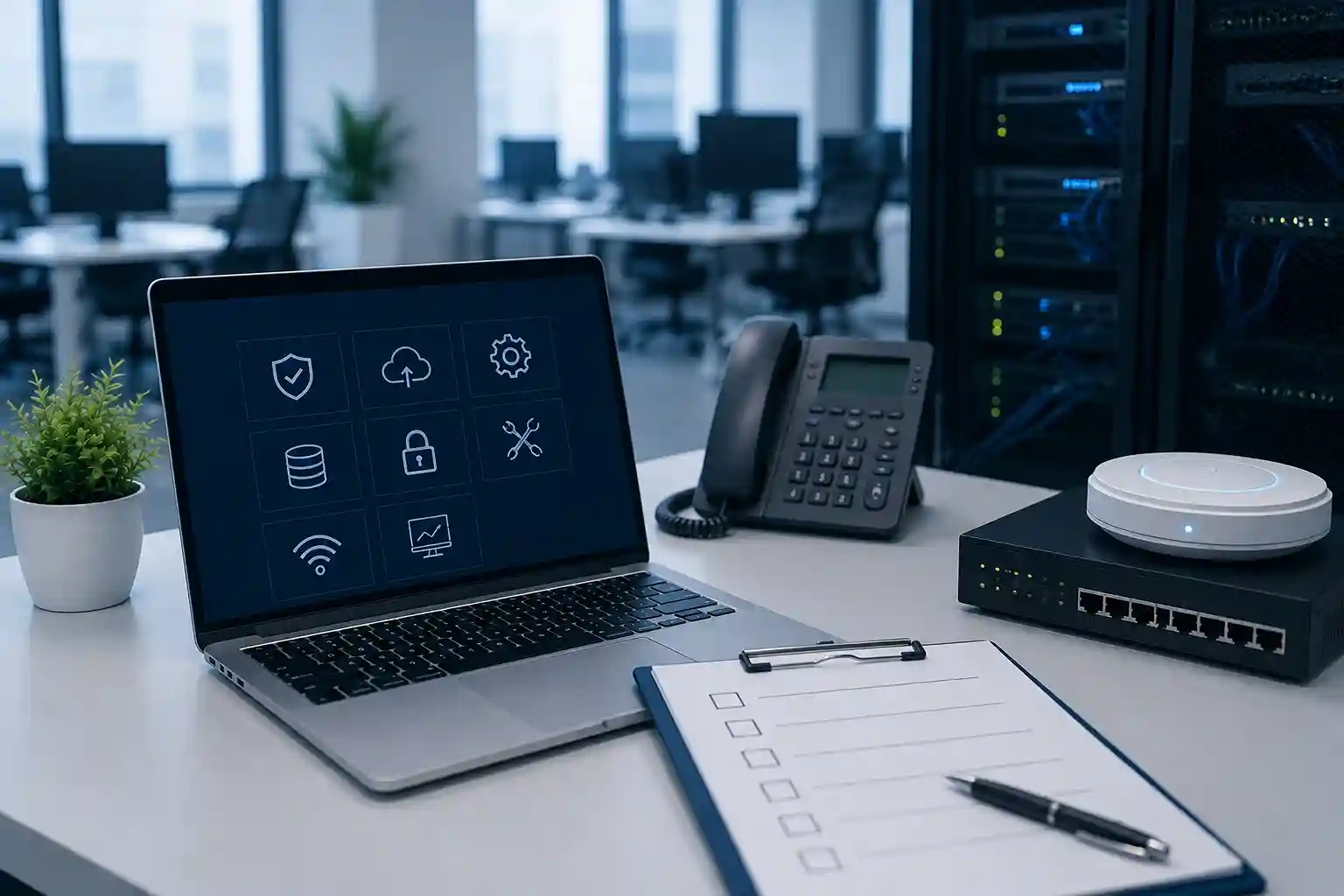
A new business quarter is more than a new set of targets—it is an opportunity to check whether your technology can actually support them. If your business is entering the next quarter with unresolved IT issues, overloaded internal resources, aging systems, or inconsistent support, those problems can quickly become operational bottlenecks. For businesses evaluating IT outsourcing in Dubai, a quarterly IT review is a practical way to identify where additional expertise or dedicated resources may be needed before business demands increase.
Instead of waiting for an IT failure to expose weaknesses, use the start of the quarter to assess your infrastructure, people, security, support processes, and technology requirements.
1. Review the IT Problems That Kept Repeating
Start with the previous quarter.
Look beyond major outages and identify the smaller issues that repeatedly interrupted employees:
- Recurring network problems
- Slow computers or applications
- Email and Microsoft 365 issues
- Printer and device failures
- User access problems
- Server performance concerns
- Repeated software errors
- Delayed IT support requests
A single recurring issue may not appear serious. However, repeated technical interruptions can consume considerable employee time and place unnecessary pressure on internal teams.
The key question is: Which IT problems should not be carried into another quarter?
If the same issues continue despite repeated troubleshooting, the business may need a more proactive support model rather than another temporary fix.
2. Check Whether Your IT Team Has Enough Capacity
Your IT requirements may have changed since the previous quarter.
Perhaps you hired more employees, opened another location, introduced new software, increased remote working, or added new business applications.
Your IT staffing model should be reviewed against those changes.
Ask:
- How many users does IT currently support?
- How many support requests are being generated?
- Are strategic IT projects being delayed?
- Is your IT team constantly dealing with urgent tickets?
- Are employees waiting too long for technical assistance?
- Is there enough expertise for specialized requirements?
If your internal team is spending most of its time keeping day-to-day operations running, there may be little capacity left for infrastructure improvement or strategic technology planning.
That is where IT outsourcing services in Dubai can provide additional technical capacity without requiring the business to build an entirely larger internal department.
3. Review Your IT Support Response
Technical support should be measured, not assumed to be effective.
Review your previous quarter’s:
- Ticket volume
- Response times
- Resolution times
- Recurring tickets
- Escalations
- Unresolved requests
- After-hours requirements
Look for patterns.
If the number of unresolved issues is increasing, it may indicate that your current support structure cannot keep pace with business requirements.
CubeZix’s managed IT approach includes centralized helpdesk support, remote troubleshooting, and on-site assistance, providing businesses with structured support rather than relying entirely on ad-hoc technical assistance.
4. Check Your Employee and Device Growth
Your IT environment should scale alongside your workforce.
Before the next quarter begins, review:
- New employees joining
- Employees leaving
- New laptops and desktops
- Software licenses
- User accounts
- Access permissions
- Remote workers
- Branch locations
A growing workforce creates additional IT responsibilities even when the technology itself remains unchanged.
If you expect significant recruitment in the next quarter, decide in advance who will handle device configuration, user onboarding, access management, troubleshooting, and ongoing support.
5. Assess Your Cybersecurity Position
Quarterly planning should also include a security review.
Check whether:
- Security patches are current
- Endpoint protection is active
- MFA is enabled where appropriate
- Firewall configurations are reviewed
- User access is still appropriate
- Former employee accounts have been removed
- Backups are functioning
- Security incidents from the previous quarter were properly addressed
Cybersecurity should not be treated as a once-a-year activity. Threats and business environments change continuously.
CubeZix provides cybersecurity services covering areas such as endpoint protection, threat monitoring, firewall management, vulnerability assessments, and data protection.
6. Review Your Infrastructure’s Health
Your servers, network equipment, endpoints, and other infrastructure should be evaluated before they become business-critical problems.
Look for:
- Aging hardware
- Storage limitations
- Network bottlenecks
- Server performance issues
- Unsupported software
- Hardware approaching end-of-life
- Insufficient backup capacity
The objective is not to replace everything every quarter.
Instead, identify what needs immediate attention, what can be monitored, and what should be included in a longer-term technology roadmap.
7. Check Whether Your IT Documentation Is Still Accurate
This is one of the easiest areas for businesses to overlook.
Review whether you have updated documentation for:
- Network architecture
- Server configurations
- Administrator accounts
- Software licenses
- Vendor contacts
- Backup procedures
- Device inventories
- Business-critical applications
If your IT documentation is outdated, even a simple technical issue can take longer to resolve.
Accurate documentation also makes it easier for an outsourced IT team to understand and support your environment.
8. Review Your Cloud and Backup Strategy
Cloud services often expand gradually as businesses adopt new applications.
Review:
- Microsoft 365 accounts
- Cloud storage usage
- Backup policies
- Data retention
- Access permissions
- Disaster recovery procedures
Your backup should not simply exist—it should be monitored and periodically tested to determine whether critical information can actually be restored.
CubeZix also provides data protection and recovery support as part of its managed IT capabilities.
9. Identify IT Projects That Were Delayed
Your quarterly review should not focus only on problems.
Look at projects that were planned but never completed.
For example:
- Network upgrades
- Cloud migration
- Cybersecurity improvements
- Hardware refreshes
- Microsoft 365 optimization
- Infrastructure upgrades
- Process automation
If operational support repeatedly pushes strategic projects to the next quarter, your business may have a resource problem.
Instead of postponing important initiatives again, consider whether additional outsourced IT expertise could provide the capacity required to complete them.
10. Decide What Should Stay Internal and What Should Be Outsourced
Not every IT function needs to be managed internally.
A practical quarterly review should categorize responsibilities into three groups:
Keep internally:
Business decisions, technology priorities, and activities requiring direct organizational ownership.
Outsource:
Specialized technical tasks, IT infrastructure management, support functions, monitoring, and other areas where external expertise can add capacity.
Share:
Functions where internal employees work alongside an external IT team.
This approach allows businesses to build an IT model around actual requirements instead of automatically increasing headcount.
When Your IT Checklist Reveals a Resource Gap
A quarterly review is valuable because it turns vague IT concerns into measurable business requirements.
If you discover that support requests are increasing, projects are being delayed, your IT team lacks specialized skills, or your business needs more hands-on technical support, the answer does not always have to be another permanent hire.
An outsourced IT resource can provide additional expertise and capacity while allowing the business to maintain control over its technology strategy.
CubeZix supports businesses through flexible IT outsourcing models, including dedicated onsite IT engineers who can work directly from the client’s office in Dubai or elsewhere in the UAE.
Why Start the Quarter With an IT Plan?
Businesses often begin a quarter with sales targets, hiring plans, marketing objectives, and financial forecasts.
IT should be part of the same planning process.
Your technology environment needs to support the people, applications, locations, security requirements, and operational targets you expect to achieve.
A structured IT review helps you identify weaknesses before they become disruptions and gives you time to decide whether you need additional support, specialized expertise, infrastructure improvements, or an outsourced IT resource.
Make CubeZix Part of Your Next-Quarter IT Plan
If your business is entering the next quarter with an overloaded IT team, unresolved technical issues, delayed projects, or growing support requirements, CubeZix can provide the additional expertise and operational support you need.
As an IT Solutions company in Dubai, CubeZix helps businesses manage technology through IT outsourcing, infrastructure support, cybersecurity, helpdesk services, and dedicated IT resources.
Instead of entering another quarter hoping your existing IT setup will cope with increased demand, assess what your business actually needs and build the right IT support model around it.
Start the next quarter with fewer IT uncertainties and a technology environment prepared for your business goals. Contact CubeZix to discuss your IT outsourcing requirements.