
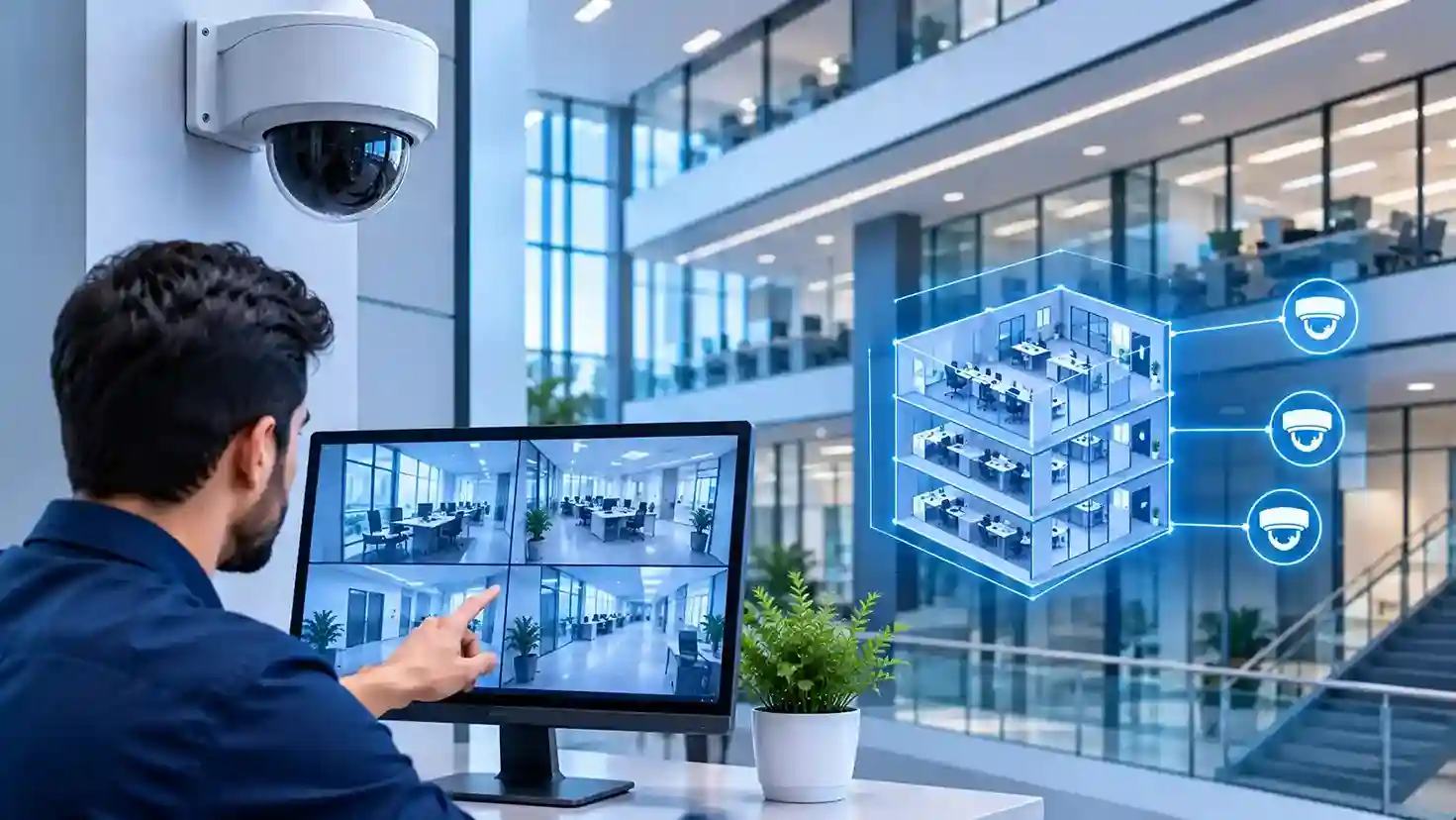
Installing CCTV cameras in a multi-floor office requires more than placing surveillance devices at entrances and corridors. Corporate buildings have multiple access points, elevators, staircases, reception areas, and restricted zones that require carefully coordinated security coverage.
CCTV coverage planning for offices involves identifying security risks, evaluating floor layouts, selecting suitable cameras, and designing a surveillance system that minimizes blind spots across different levels.
Businesses planning new installations or upgrading existing surveillance systems can work with a professional CCTV installation company in Dubai to develop a comprehensive camera placement strategy that supports workplace security and applicable SIRA requirements.
What Is CCTV Coverage Planning for Multi-Floor Offices?
CCTV coverage planning is the process of determining where security cameras should be installed, what areas they should monitor, and how surveillance footage will be recorded and managed.
For multi-floor corporate offices, the planning process must account for shared entrances, internal corridors, elevator access, emergency exits, and sensitive business areas.
The goal is to achieve effective security coverage with the appropriate number of cameras, rather than installing more cameras than necessary.
A properly designed office CCTV system should provide:
- Clear visibility of important entrances and exits.
- Coverage of common areas and movement between floors.
- Monitoring of restricted or sensitive access points.
- Reliable recording and authorized footage retrieval.
- Capacity for future office expansion.
1. Identify Security Risks on Every Office Floor
Before selecting cameras, businesses should evaluate how employees, visitors, contractors, and delivery personnel move throughout the building.
Different floors may have different security requirements. For example, the ground floor may receive external visitors, while upper floors contain employee workspaces and restricted departments.
Security assessments should identify:
- Main and secondary access points.
- Visitor reception and waiting areas.
- Elevator lobbies and staircases.
- Server rooms and equipment storage areas.
- Emergency exits and restricted corridors.
Reviewing these areas helps determine where cameras are needed and what image quality is required.
CubeZix also discusses the importance of planning surveillance around actual security risks in its article, Is Your CCTV System Designed for Your Business or Just Installed?.
2. Plan CCTV Camera Placement Floor by Floor
Camera placement is one of the most important elements of commercial office surveillance.
Rather than applying the same camera arrangement across every floor, businesses should design coverage according to each floor’s layout and purpose.
| Office area | Recommended coverage objective |
|---|---|
| Main entrance | Capture individuals entering and leaving |
| Reception | Monitor visitor activity and access points |
| Elevator lobby | Observe movement between floors |
| Staircase | Monitor access and movement |
| Corridors | Identify activity and reduce blind spots |
| Server room entrance | Monitor restricted access |
| Emergency exit | Observe door activity and unauthorized access |
| Parking access | Monitor vehicle and pedestrian movement |
These are general planning recommendations. Final camera locations and image-detail requirements should be established through a site survey and applicable SIRA specifications.
Cameras should be positioned to minimize obstructions from partitions, doors, ceiling structures, and reflective surfaces.
3. Prevent CCTV Blind Spots Between Floors
One common mistake in multi-floor CCTV installation is concentrating cameras at main entrances while overlooking internal movement routes.
Blind spots frequently occur near staircase landings, corridor intersections, elevator exits, and areas obstructed by structural columns.
Businesses should review camera fields of view using actual floor plans and verify coverage through onsite testing.
Overlapping camera views may be useful in critical locations, particularly where a single camera cannot capture all relevant activity.
However, overlapping coverage should serve a defined security purpose rather than create unnecessary recording and storage requirements.
4. Select the Right CCTV Cameras for Corporate Offices
Different areas of a multi-floor commercial building may require different surveillance equipment.
Dome cameras are commonly suitable for indoor corridors, reception areas, and office lobbies because of their compact design.
Bullet cameras may be appropriate for external entrances, parking areas, and longer viewing distances.
Varifocal cameras allow installers to adjust the viewing angle for specific coverage requirements.
Pan-tilt-zoom (PTZ) cameras can support active monitoring in larger permitted areas, but they should not replace fixed cameras where continuous coverage is required.
Businesses should consider resolution, lighting conditions, field of view, mounting height, and environmental exposure before selecting equipment.
5. Design CCTV Network and Recording Infrastructure
A multi-floor CCTV installation requires a reliable network capable of transmitting video from cameras across different building levels.
IP cameras commonly connect through Power over Ethernet (PoE) switches, while network video recorders (NVRs) manage video recording and storage.
Important infrastructure considerations include network bandwidth, switch capacity, cable distances, centralized recording, backup power, and secure administrative access.
For larger offices, fiber optic connections may be appropriate between floors or network distribution cabinets.
Working with providers of structured cabling services in Dubai helps businesses develop organized CCTV cabling routes and reliable inter-floor connectivity.
CubeZix’s article on how structured cabling improves security systems in corporate spaces explains the importance of dependable connectivity for surveillance infrastructure.
6. Consider SIRA CCTV Requirements in Dubai
Commercial CCTV installations in Dubai may be subject to requirements established by the Security Industry Regulatory Agency (SIRA).
The applicable requirements depend on the building classification and business activities.
Dubai’s 2025 Preventive Systems Manual specifies surveillance coverage for multi-story commercial buildings, including entrances, main lobbies, reception desks, elevator areas, staircases, corridors, and emergency exits.
Businesses should confirm applicable camera specifications, recording retention, system monitoring, and approval requirements before installation.
CCTV systems must also respect privacy boundaries and avoid unauthorized monitoring of private areas.
A professional security assessment helps determine which requirements apply to a particular office building.
7. Calculate CCTV Storage Requirements Across Multiple Floors
As the number of cameras increases, recording and storage requirements grow.
For example, a five-floor office with eight cameras per floor would require infrastructure supporting 40 camera feeds.
However, actual storage requirements depend on several factors:
- Camera resolution and frame rate.
- Video compression settings.
- Continuous or event-based recording.
- Recording retention requirements.
- Number of active cameras.
Businesses should calculate storage capacity using the expected recording bitrate and the applicable retention period rather than relying on camera count alone.
8. Coordinate CCTV Planning with Office Fit-Out
For new offices, CCTV planning should begin before ceiling panels, partitions, and network cabling are finalized.
Early coordination allows businesses to establish camera locations, power requirements, equipment cabinets, and cable routes without expensive modifications after construction.
CubeZix’s guide, 12 IT Decisions That Must Be Finalized Before Office Fit-Out Starts, highlights the importance of coordinating CCTV, access control, structured cabling, and IT infrastructure during workplace planning.
This approach is particularly beneficial for businesses opening multi-floor headquarters or expanding existing office premises.
9. Test CCTV Coverage Before Final Handover
Once installation is completed, every camera should be tested under actual operating conditions.
Testing should confirm that required areas are visible, recorded footage is usable, timestamps are accurate, and authorized personnel can retrieve recordings.
Businesses should also verify network reliability, recording continuity, storage capacity, and system recovery following power interruptions.
A documented coverage map and maintenance schedule make it easier to identify future problems or plan additional cameras.
Frequently Asked Questions
How many CCTV cameras are needed for a multi-floor office?
The number depends on floor area, entrances, corridors, elevators, restricted zones, and applicable security requirements. A professional site survey helps determine the required coverage and camera count.
Should every floor have a separate CCTV recorder?
Not necessarily. Multiple floors can connect to centralized recording infrastructure when bandwidth, storage, reliability, and applicable compliance requirements are adequately addressed.
Where should CCTV cameras be installed in corporate offices?
Common locations include entrances, reception areas, elevator lobbies, staircases, corridors, emergency exits, and sensitive access points. Exact placement depends on the security assessment.
Can CCTV systems be expanded when an office adds more floors?
Yes. A scalable IP CCTV system can support additional cameras, provided the network, PoE capacity, recording licenses, and storage infrastructure can accommodate expansion.
Plan Your Multi-Floor Office CCTV Installation with CubeZix
Effective CCTV coverage planning helps Dubai businesses reduce surveillance blind spots, improve security visibility, and maintain more reliable monitoring across multiple office floors.
Whether your organization is opening a new corporate headquarters, occupying additional floors, or upgrading an existing surveillance system, professional planning can help ensure the installation meets operational and applicable regulatory requirements.
Looking for CCTV installation services for a multi-floor commercial office in Dubai?
Explore CubeZix’s commercial CCTV installation services in Dubai and request a site assessment to plan camera placement, recording infrastructure, and coverage requirements for your business.