
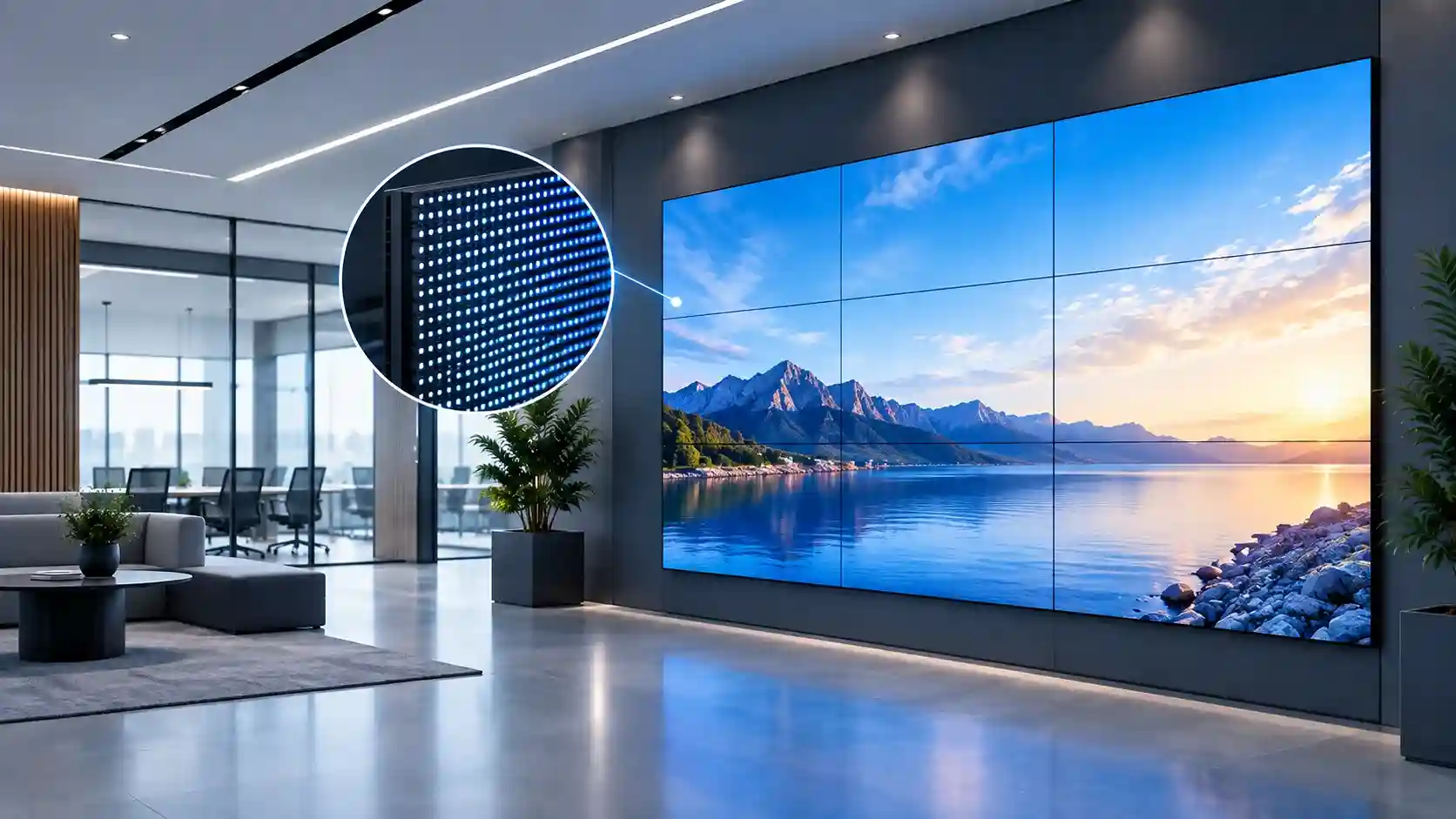
Choosing the right LED video wall pixel pitch starts with one question: How close will people be to the screen? In general, the closer viewers are, the finer the pixel pitch needs to be. However, viewing distance is only part of the decision. Screen dimensions, content type, required resolution, room lighting, application and budget should all influence the final specification.
For Dubai businesses planning a corporate display, showroom screen, command centre, reception wall or meeting-room installation, CubeZix can help assess these requirements and design professional video wall solutions in Dubai around the actual space rather than simply recommending the smallest—and most expensive—pixel pitch available.
What Is Pixel Pitch on an LED Video Wall?
Pixel pitch is the distance, measured in millimetres, between the centres of neighbouring LED pixels on a display.
You may therefore see LED video walls described as:
- P0.9
- P1.2
- P1.5
- P1.8
- P2.5
- P3
- P4
The “P” refers to pixel pitch.
For example, a P1.5 LED video wall has approximately 1.5 mm between adjacent pixels.
A smaller number means the LEDs are positioned closer together. This creates a higher pixel density and can produce a smoother, more detailed image when viewers are standing close to the screen.
A larger pixel pitch places LEDs farther apart. It can still deliver excellent image quality when viewed from an appropriate distance and may be more cost-effective for large-format installations.
Smaller pixel pitch = higher pixel density and better close-range viewing.
But that does not automatically mean that the smallest available pitch is the best option.
The right choice is the pitch that gives your audience the required image quality from the actual viewing distance without unnecessarily increasing project cost.
Why Does Pixel Pitch Matter So Much?
Pixel pitch influences several aspects of an LED video wall at the same time.
Image Detail
A fine-pitch LED display contains more pixels within the same physical space. This allows smaller text, charts, graphics and detailed visual content to appear clearer.
Viewing Distance
When someone moves very close to a display with a large pixel pitch, the individual pixels may become noticeable.
Fine-pitch LED reduces that effect and is therefore particularly useful in applications where people may stand or sit close to the video wall.
Resolution
Two LED walls with identical physical dimensions can have very different native resolutions.
The video wall with the smaller pixel pitch contains more pixels and therefore produces a higher native resolution.
Cost
Fitting more LEDs into the same display area normally increases system complexity and equipment cost.
This is why specifying an unnecessarily fine pixel pitch can significantly increase the project budget without necessarily creating a noticeable improvement for the intended audience.
What Is the Best Pixel Pitch for an LED Video Wall?
There is no single best pixel pitch for every business.
A useful starting framework is:
| Pixel Pitch | Common Application Type | Typical Requirement |
|---|---|---|
| Below 1.0 mm | Premium control rooms, executive spaces, specialised visualization | Extremely close viewing and high detail |
| 1.0–1.5 mm | Boardrooms, monitoring rooms, premium corporate displays | Close viewing with detailed content |
| 1.5–1.9 mm | Meeting rooms, reception areas, showrooms, indoor commercial spaces | Balanced detail and viewing distance |
| 2.0–2.9 mm | Larger lobbies, retail displays, digital signage | Moderate viewing distances |
| 3 mm+ | Large-format displays and longer-distance applications | Scale and visibility from farther away |
These ranges should be treated as planning guidance rather than fixed specifications. The correct solution depends on the room, content, dimensions and actual viewer positions.
1. Start With the Nearest Viewing Distance
Viewing distance should be one of the first measurements taken during video wall planning.
Imagine two installations.
A company installs an LED wall inside an executive boardroom where the nearest person sits only a few metres away.
Another company installs a large LED wall across the reception area of a spacious commercial building where visitors see it from considerably farther away.
The same pixel pitch would not necessarily be appropriate for both installations.
The boardroom display may need a finer pitch because people are closer and may need to read detailed presentations, spreadsheets and text.
The lobby screen may be used mainly for branding, promotional videos and large graphics viewed from farther away, allowing a larger pitch to deliver excellent results without over-specifying the installation.
Key question: What is the closest realistic position from which someone will regularly view the screen?
Start there, not with the product catalogue.
2. Consider What You Will Display
Pixel pitch should also be selected around your content.
Text, Dashboards and Detailed Data
Applications involving:
- Business dashboards
- Financial information
- Operational data
- Maps
- Security information
- Small text
- Technical diagrams
usually benefit from greater pixel density.
This is especially important in control rooms and monitoring environments where operators may need to interpret detailed information quickly.
Presentations and Video Conferencing
A meeting-room LED wall may need to display presentation slides, documents, remote participants and shared screens.
If your display forms part of a wider collaboration environment, CubeZix can integrate it with suitable video conferencing solutions in Dubai and supporting AV infrastructure.
Branding and Promotional Content
A showroom or lobby video wall displaying large photographs, videos, advertisements or branding may not require the same fine pitch as a control-room display.
The content is larger and viewers may be farther from the screen.
Understanding what will actually appear on the wall can therefore prevent unnecessary expenditure.
3. Match Pixel Pitch With Screen Size and Resolution
Pixel pitch, physical screen dimensions and resolution are directly connected.
Suppose you want a particular native resolution.
With a very fine pixel pitch, that resolution can be achieved within a smaller physical display.
With a larger pitch, a much larger display surface may be required to achieve the same number of pixels.
This is why selecting a video wall purely by saying:
“We need 4K.”
is not enough.
You also need to determine:
- Available wall dimensions
- Target aspect ratio
- Viewing distance
- Content resolution
- Required screen dimensions
- Pixel pitch
- Signal sources
A professional integrator should evaluate these factors together.
4. Think About the Room Before Choosing the Display
The physical environment can change the specification dramatically.
Before selecting an LED wall, assess:
- Wall dimensions
- Ceiling height
- Viewing angles
- Ambient lighting
- Windows and natural light
- Available power
- Ventilation
- Cable pathways
- Network availability
- Mounting structure
- Maintenance access
This becomes particularly important when the video wall is being installed as part of a new workplace.
Businesses designing a new location can use CubeZix’s new office IT setup services in Dubai to coordinate networking, connectivity, security, communication and display requirements within the broader technology plan.
You can also review our new office IT setup checklist before finalising the technology infrastructure for a new premises.
5. Don’t Ignore Cabling and Signal Distribution
Buying an excellent LED display does not guarantee an excellent video wall.
The supporting infrastructure matters.
A professional installation may require coordination between:
- LED cabinets
- Video processors
- Controllers
- Computers
- Media players
- Network equipment
- AV sources
- Power systems
- Video conferencing devices
- CCTV systems
- Content management platforms
Poorly planned connectivity can lead to signal problems, difficult maintenance and limitations when the business later needs to add new sources.
CubeZix provides structured cabling services in Dubai for AV systems, video walls, control rooms, data networks and other business technology environments.
Planning cabling before installation also makes future upgrades considerably easier.
6. Pixel Pitch for Control Rooms and CCTV Monitoring
Control rooms have different priorities from promotional displays.
Operators may need to monitor:
- CCTV camera feeds
- Security alerts
- Maps
- System dashboards
- Analytics
- Network information
- Multiple applications simultaneously
Here, readability and reliability may be more important than creating a dramatic visual effect.
Viewing distances can also be relatively short.
A finer-pitch display may therefore make sense when small windows, labels and detailed feeds need to remain clear.
Companies developing security monitoring environments should consider the video wall alongside the wider CCTV installation in Dubai rather than treating the display and surveillance platform as separate projects.
This helps ensure that sources, controllers, cabling and display layouts are designed to operate together.
7. Pixel Pitch for Boardrooms and Meeting Rooms
Boardrooms increasingly display more than PowerPoint presentations.
A modern meeting room may need to show:
- Video conference participants
- Shared presentations
- Business dashboards
- Spreadsheets
- Documents
- Multiple sources
- Collaboration applications
Because attendees sit relatively close to the display, fine pixel pitch becomes more important than it would be for a lobby display seen from across a large room.
However, choosing an extremely small pitch simply because it is technically superior can still be unnecessary.
The aim should be to provide enough pixel density that normal meeting content is clear from the nearest seating position.
8. Pixel Pitch for Retail Stores and Showrooms
Retail applications introduce different priorities.
A display may be used to:
- Capture attention
- Promote products
- Launch campaigns
- Demonstrate products
- Display branded videos
- Create immersive customer experiences
Viewers may approach the screen closely, particularly when the wall forms part of an interactive showroom or premium retail environment.
Fine-pitch LED can help maintain a smooth image at these shorter distances.
However, a large LED feature positioned high above customers or across a wide showroom may perform effectively with a larger pitch.
Again, the correct specification depends on how people actually experience the display.
9. Should You Always Choose the Smallest Pixel Pitch?
No.
This is one of the most important decisions for businesses evaluating LED video walls.
Smaller pixel pitch can provide:
- Greater pixel density
- Better close-range viewing
- More detailed images
- Higher resolution within a given screen area
But those advantages come with a higher investment.
If people will never be close enough to notice the difference between two pitch options, paying for the finer specification may deliver very little practical benefit.
A good video wall design balances:
image quality + viewing distance + application + screen dimensions + budget.
The objective should be appropriate specification, not maximum specification.
10. Consider the Entire IT and AV Environment
An LED video wall rarely operates completely independently.
It may connect to:
- Corporate networks
- Meeting-room equipment
- Computers
- CCTV systems
- Media players
- Digital signage platforms
- Network switches
- Video processors
- Content servers
For this reason, display planning should be coordinated with your wider IT infrastructure solutions.
Businesses upgrading several systems simultaneously should also understand the key components of robust IT infrastructure so that network, cabling, security and AV requirements are planned as one environment rather than as isolated projects.
This becomes increasingly important when future expansion is expected.
A Simple LED Video Wall Pixel Pitch Checklist
Before requesting an LED video wall quotation, answer these questions:
1. What is the closest viewing distance?
Measure where the nearest regular viewer will sit or stand.
2. What is the farthest viewing distance?
Consider whether users across the entire space need the same level of detail.
3. What will appear on the display?
Videos, advertisements and branding have different requirements from dashboards and spreadsheets.
4. How large is the available wall?
Measure width, height and any physical restrictions.
5. What resolution do you need?
Think about source content as well as the native resolution of the finished display.
6. How bright is the room?
Natural and artificial lighting should be assessed.
7. How many content sources are required?
Determine whether you need laptops, CCTV feeds, media players, conferencing systems or multiple simultaneous inputs.
8. Will the system expand later?
Consider future displays, sources and integrations.
9. How will cabling reach the wall?
Plan network, AV and power infrastructure early.
10. Who will maintain the system?
Maintenance accessibility should be considered during design rather than after installation.
Why Professional Video Wall Planning Matters
Pixel pitch is only one specification on a data sheet, but choosing it incorrectly can affect the entire project.
A pitch that is too large may produce visible pixel structure at normal viewing distances.
A specification that is unnecessarily fine can increase project cost without providing a meaningful improvement for users.
Professional video wall planning should therefore begin with the business requirement and installation environment.
At CubeZix, we assess factors such as:
- Application
- Viewing distance
- Wall dimensions
- Screen size
- Pixel pitch
- Content requirements
- Connectivity
- Cabling
- Video controllers
- Existing systems
- Installation requirements
- Future expansion
The result is a video wall designed around how your business will actually use it.
Planning an LED Video Wall in Dubai?
If you are comparing P0.9, P1.2, P1.5, P1.8, P2.5 or other LED video wall options, don’t choose based on pixel pitch alone.
The correct specification should balance image quality, viewing distance, display size, content and budget.
CubeZix provides end-to-end video wall solutions in Dubai, from requirement assessment and technology selection to installation, cabling, controller configuration, testing and technical support.
For businesses that require ongoing technology support after deployment, CubeZix also provides IT AMC services in Dubai covering broader business IT infrastructure and support requirements.
Talk to CubeZix about your space, viewing distance and intended application, and our team can help identify an appropriate video wall configuration for your business.
Frequently Asked Questions About LED Video Wall Pixel Pitch
What is pixel pitch in an LED video wall?
Pixel pitch is the distance between neighbouring LED pixels, normally measured in millimetres. A smaller pixel pitch places pixels closer together and increases pixel density, which can improve image detail at shorter viewing distances.
What is the best pixel pitch for an LED video wall?
There is no universal best pixel pitch. The correct choice depends primarily on viewing distance, screen size, content type, required resolution, environment and budget.
Is a smaller pixel pitch always better?
Not necessarily. Smaller pixel pitches provide higher pixel density, but they usually cost more. If viewers are far from the screen, they may not notice enough improvement to justify the additional investment.
Is a 1.5mm pixel pitch good for an indoor LED wall?
A 1.5mm LED wall can be suitable for many indoor environments requiring relatively close viewing, including meeting spaces, showrooms and corporate installations. The final choice should still be based on actual viewing distance and content requirements.
What pixel pitch should I use for a control room?
Control rooms often benefit from fine-pitch LED because operators may sit close to the screen and need to read detailed dashboards, labels, maps or camera feeds. The precise pitch should be calculated around the nearest operator position and required resolution.
What pixel pitch is suitable for a boardroom?
Boardrooms commonly require a relatively fine pitch because participants view the display from short distances and may need to read detailed presentations or documents. Screen size, seating layout and native resolution should all be assessed before selecting a pitch.
Does pixel pitch affect LED video wall resolution?
Yes. For video walls of the same physical size, a smaller pixel pitch fits more pixels into the display area and therefore produces a higher native resolution.
Does pixel pitch affect the cost of a video wall?
Yes. Fine-pitch LED generally requires a greater number of LED pixels and more sophisticated manufacturing, so reducing pixel pitch can increase equipment cost. This is why choosing the smallest available pitch is not always the most cost-effective approach.
How do I choose between P1.2, P1.5 and P2.5 LED?
Start with the closest viewing distance and the level of detail in your content. A P1.2 or P1.5 system may be appropriate where viewers are relatively close or content is highly detailed, while P2.5 can be appropriate for installations viewed from farther away. A site assessment is the safest way to determine the correct configuration.
Can CubeZix install LED video walls in Dubai?
Yes. CubeZix provides video wall consultation, system design, LED and LCD display selection, installation, cabling, controller configuration, testing, integration and technical support for commercial environments in Dubai.